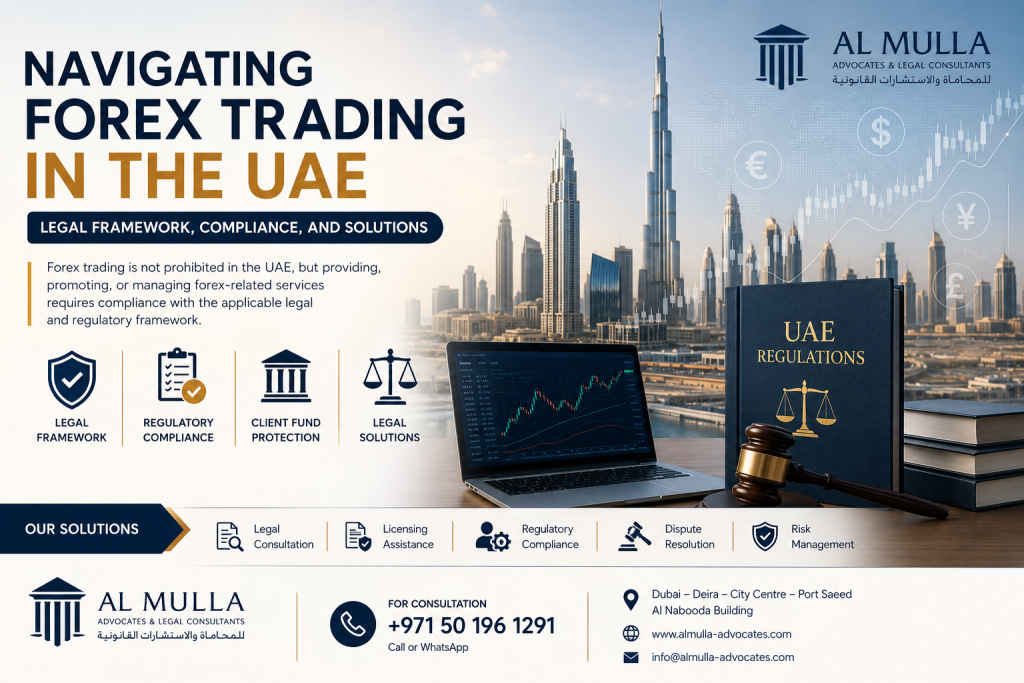
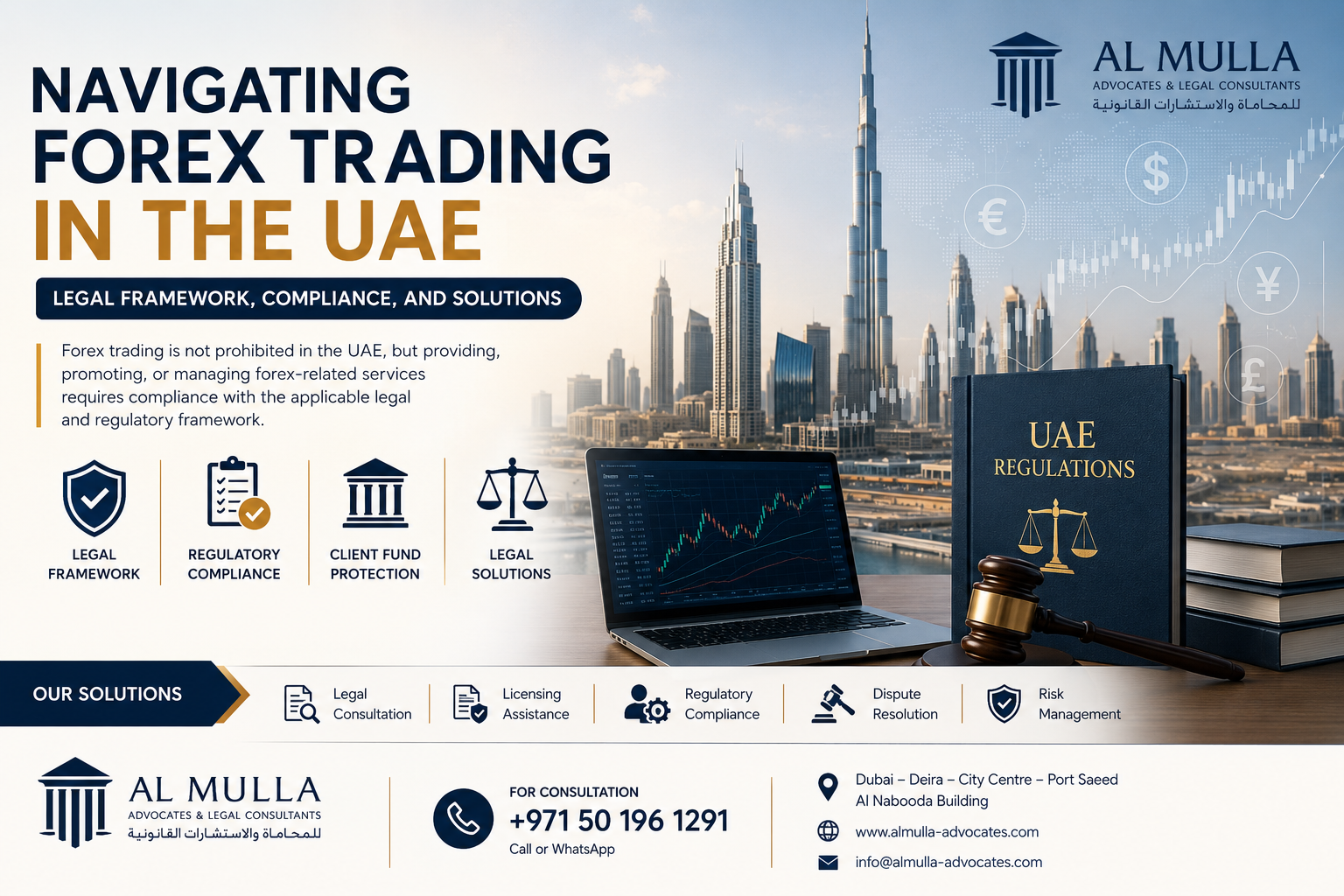
Navigating Forex Trading in the UAE: Legal Framework, Compliance, and Solutions
The United Arab Emirates has firmly established itself as a premier global financial hub, with forex trading emerging as one of the most dynamic and lucrative sectors in the country’s economy. As we move through 2026, the UAE’s forex market continues to attract international investors, brokers, and traders seeking to capitalize on the nation’s strategic location, robust infrastructure, and progressive regulatory environment. However, with opportunity comes responsibility—and the legal landscape governing forex activities in the UAE has become increasingly sophisticated and stringent.
Navigating Forex Trading in the UAE is essential for understanding the market landscape and ensuring compliance with local regulations.
At Azza Ebrahim Hasan Almulla Advocates and Legal Consultants, we have witnessed firsthand the growing interest in forex trading and the corresponding need for expert legal guidance. Whether you are an international broker seeking to establish a presence in the UAE, an investor exploring trading opportunities, or an individual facing regulatory challenges, understanding the legal framework is essential for success and compliance.
Whether you are new to Navigating Forex Trading in the UAE or an experienced trader, knowledge is key.
Is Forex Trading Legal in the UAE?
Many individuals are interested in Navigating Forex Trading in the UAE due to its growth potential.
The short answer is yes—forex trading is entirely legal in the UAE, provided that you operate through a properly authorized, regulated corporate entity. The UAE has developed a comprehensive regulatory framework that balances market accessibility with robust oversight to protect investors and maintain the integrity of the financial system.
Understanding the basics of Navigating Forex Trading in the UAE can help you build a successful strategy.
However, the regulatory environment has undergone significant transformation. Effective January 1, 2026, the Securities and Commodities Authority (SCA) was reconstituted as the Capital Market Authority (CMA) under Federal Decree Law No. 32 of 2025. This change reflects the UAE’s commitment to evolving its regulatory infrastructure to meet international standards and address emerging challenges in the financial sector. Importantly, while the name has changed, regulatory powers, supervisory scope, and enforcement authority remain fundamentally unchanged.
Navigating Forex Trading in the UAE requires adherence to tightened regulations and compliance measures.
Carrying on any financial service or marketing investment activities onshore without a CMA license is now an offense under Article 71 of Federal Decree-Law No. 33 of 2025, which carries severe penalties including statutory fines of up to AED 250 million, mandatory imprisonment of not less than one year, immediate premises closure, and blocking of associated corporate websites. These penalties are among the most stringent in the region and underscore the UAE’s determination to maintain the integrity of its financial markets.
For those interested in Navigating Forex Trading in the UAE, seeking expert advice can be beneficial.
The Regulatory Framework: Key Authorities
In the context of Navigating Forex Trading in the UAE, it’s crucial to understand regulatory authorities.
The Capital Market Authority (CMA)
Navigating Forex Trading in the UAE can be simplified by staying informed of regulatory updates.
Formerly the Securities and Commodities Authority (SCA), the CMA is the primary regulator for financial services in the UAE mainland. The authority issues licenses for forex brokerage activities and ensures compliance with applicable laws and regulations. The CMA has established several categories of licenses, with CAT 5 being particularly relevant for firms engaged in “Introduction to Financial Services & Financial Consultancy.”
Understanding CMA’s role in Navigating Forex Trading in the UAE is vital for compliance.
The transition from SCA to CMA has been largely administrative, with all existing SCA licenses remaining valid. However, the CMA has signaled its intention to modernize the regulatory approach, potentially introducing new rules and guidelines for the forex sector. Businesses must stay informed of these developments to maintain compliance.
The Central Bank of the UAE (CBUAE)
Navigating Forex Trading in the UAE involves knowing how the Central Bank regulates the market.
The Central Bank plays a crucial role in overseeing financial institutions, including forex exchanges and money transfer companies. The CBUAE has introduced new rules for currency exchange and money transfers, effective from July 10, 2025, including new license categories and significantly increased capital requirements. The minimum paid-up capital for currency exchange operations has been raised to AED 25 million (approximately USD 6.8 million) to ensure stability and consumer protection.
Additionally, the CBUAE has become the first central bank in the Arab world to adopt the FX Global Code, signing a Statement of Commitment to this international standard for good practices in the foreign exchange market. This commitment underscores the UAE’s dedication to maintaining a transparent and fair forex market, aligning with international best practices and enhancing the country’s reputation as a trusted financial center.
Navigating Forex Trading in the UAE means adhering to the FX Global Code for best practices.
Dubai Financial Services Authority (DFSA)
For firms operating within the Dubai International Financial Centre (DIFC), the DFSA serves as the independent regulator. The DIFC offers a common law framework and is a preferred jurisdiction for many international forex brokers. The DFSA caps retail client leverage at 1:30 on major forex pairs, aligned with standards applied in Europe and Australia. This consumer protection measure ensures that retail traders are not exposed to excessive risk.
For firms, Navigating Forex Trading in the UAE aligns with compliance and operational excellence.
Financial Services Regulatory Authority (FSRA)
For firms operating within the Abu Dhabi Global Market (ADGM), the FSRA serves as the independent regulator. ADGM operates under English common law and offers a sophisticated regulatory environment comparable to leading international financial centers. The FSRA has also adopted the FX Global Code, demonstrating its commitment to market integrity.
Navigating Forex Trading in the UAE includes understanding ADGM’s regulatory standards.
Types of Forex Licenses in the UAE
Navigating Forex Trading in the UAE requires knowledge of various license types available.
CMA Licensing Categories
The CMA offers several categories of licenses, each suited to different business models:
Choosing the right license is a key part of Navigating Forex Trading in the UAE efficiently.
CMA Category 1 — Full Brokerage License:
-
Permits direct execution against UAE retail clients
Navigating Forex Trading in the UAE with a Full Brokerage License offers direct client access.
-
Allows holding client assets in UAE accounts
-
Minimum capital: Approximately AED 10 million (USD 2.7 million)
For those Navigating Forex Trading in the UAE, understanding capital requirements is critical.
-
Timeline: 9 to 12 months
-
Complexity: High
Navigating Forex Trading in the UAE requires firms to keep complexity in check.
CMA Category 2 — Dealing in Foreign Exchange as Principal:
-
Allows proprietary trading and market-making activities
Navigating Forex Trading in the UAE can involve market-making activities under specific licenses.
-
Permits dealing in foreign exchange as a principal
-
Minimum capital: Approximately AED 5 million
Understanding CMA Category 2 is essential for those Navigating Forex Trading in the UAE.
-
Timeline: 6 to 9 months
-
Complexity: Medium to High
Navigating Forex Trading in the UAE with a Dealing as Agent license can be advantageous.
CMA Category 3 — Dealing in Foreign Exchange as Agent:
-
Allows brokerage activities without holding client funds
Navigating Forex Trading in the UAE without holding client funds is possible with specific licenses.
-
Permits execution of trades on behalf of clients
-
Minimum capital: Approximately AED 2 million
Navigating Forex Trading in the UAE can be streamlined by choosing appropriate licensing paths.
-
Timeline: 6 to 9 months
-
Complexity: Medium
Navigating Forex Trading in the UAE requires a clear understanding of licensing complexities.
CMA Category 5 — Financial Consultations and Introduction:
-
Allows marketing, client introduction, and financial consultation
Navigating Forex Trading in the UAE with a Category 5 license opens marketing opportunities.
-
Does NOT permit executing trades or holding client funds
-
Minimum capital: Low / minimal
Navigating Forex Trading in the UAE can be achieved with minimal capital requirements.
-
Timeline: 3 to 6 months
-
Complexity: Low to Medium
Understanding the Category 5 demand is part of Navigating Forex Trading in the UAE landscape.
Category 5 is currently the most sought-after licence in the CFD and FX sector in the UAE. Recent grantees include Pepperstone, XM, Finalto, Exinity, and VT Markets, confirming that this is now the standard route for established international brokers establishing a regulated UAE marketing presence. This license allows brokers to legally market their services and introduce clients to regulated trading platforms without the capital-intensive requirements of a full brokerage license.
DFSA Licensing
Navigating Forex Trading in the UAE with DFSA licensing can enhance credibility.
For DIFC-based operations, the DFSA Category 3A Brokerage License requires significantly higher capital, with minimum paid-up capital of USD 500,000 (approximately AED 1.8 million). This license permits full brokerage activities within the DIFC, including client onboarding and execution services.
DMCC Licensing
Navigating Forex Trading in the UAE requires awareness of proprietary trading options.
The Dubai Multi Commodities Centre (DMCC) offers proprietary trading licenses for firms engaged in trading with their own capital. The minimum share capital requirement is AED 50,000. This license is suitable for proprietary trading firms that do not offer services to retail clients.
Recent Enforcement Actions: A Warning to Non-Compliant Firms
For success in Navigating Forex Trading in the UAE, compliance is non-negotiable.
The UAE has demonstrated its commitment to enforcing AML/CFT regulations through decisive action against violators. In June 2025, the CBUAE revoked the license of Sundus Exchange and imposed a financial penalty of AED 10 million following examinations that uncovered failures in adhering to UAE laws on Anti-Money Laundering and Combating the Financing of Terrorism.
The action was taken under Article 14 of Federal Decree Law No. (20) of 2018, and the exchange was struck off the official licences register. The CBUAE emphasized that all exchange house operators—including owners and employees—are expected to fully comply with local laws and the standards set by the regulator. This enforcement action reflects the UAE’s broader strategy to strengthen financial oversight and align its AML/CFT frameworks with global standards.
Navigating Forex Trading in the UAE involves understanding enforcement actions and penalties.
The UAE is actively working to close compliance gaps in the financial system, making regulatory compliance a non-negotiable requirement for any forex-related business. The message is clear: non-compliance will not be tolerated, and the consequences are severe.
Penalties for Operating Without a License
Navigating Forex Trading in the UAE means being aware of strict penalties for unlicensed operations.
The penalties for operating an unlicensed forex brokerage in the UAE have become increasingly severe. Under Federal Decree-Law No. 33 of 2025, the consequences include:
-
Statutory fines of up to AED 250 million — This represents one of the highest penalty thresholds in the region
Knowledge of the penalties for unlicensed forex trading is key when Navigating Forex Trading in the UAE.
-
Mandatory imprisonment of not less than one year — Criminal liability for individuals involved in unlicensed activities
-
Immediate physical premises closure — Regulatory authorities can shut down operations without prior warning
Navigating Forex Trading in the UAE involves understanding banking challenges.
-
Website blocking and removal of digital presence — Digital assets can be seized and taken offline
These penalties reflect the UAE’s determination to maintain the integrity of its financial markets and protect investors from unregulated operators. The message is clear: operating without proper authorization carries substantial risk.
Managing banking relationships is crucial for Navigating Forex Trading in the UAE effectively.
Banking Challenges for Forex Companies
One area that frequently surprises new forex operators is the complexity of banking in the UAE. UAE banks apply enhanced due diligence to all financial services firms, requiring detailed scrutiny of business plans, AML controls, target client geography, transaction flow projections, and beneficial ownership structure.
Navigating Forex Trading in the UAE can be challenging due to banking complexities.
Working with a bank that has established forex client relationships is more effective than approaching multiple banks independently. Successful account opening requires:
-
A clear beneficial ownership structure — Transparency regarding ultimate beneficial owners is essential
Navigating Forex Trading in the UAE requires clear ownership structures to facilitate banking.
-
Comprehensive AML frameworks — Demonstrated compliance with CBUAE AML regulations
-
Detailed business evaluation and financial projections — Evidence of financial stability and business viability
For firms Navigating Forex Trading in the UAE, AML compliance is essential.
-
A UAE corporate bank account with the required share or paid-up capital deposited
Common Legal Challenges in Forex Operations
Navigating Forex Trading in the UAE entails addressing common legal challenges in operations.
Anti-Money Laundering (AML) and Counter-Terrorism Financing (CTF) Compliance
AML/CFT compliance is the cornerstone of regulatory oversight in the UAE forex sector. Article (30) of CBUAE regulations stipulates severe penalties for individuals who possess, conceal, or conduct transactions in funds with indications of illegitimacy. Conviction carries imprisonment for not less than three months and fines of not less than AED 50,000, or either of these penalties.
Part of Navigating Forex Trading in the UAE includes understanding AML/CFT compliance requirements.
To maintain compliance, forex businesses must implement:
-
Robust KYC procedures — Verification of client identity and source of funds
Effective KYC procedures are vital for Navigating Forex Trading in the UAE.
-
Transaction monitoring systems — Detection of suspicious activity
-
Regular reporting — Submission of reports to the Financial Intelligence Unit (FIU)
Regular reporting is critical for Navigating Forex Trading in the UAE successfully.
-
Employee training — Ongoing AML/CFT awareness programs
Misclassification of Business Activities
Navigating Forex Trading in the UAE requires careful classification of business activities.
Many firms encounter difficulties because their initial applications are structured incorrectly. In one case, a firm that had previously worked with two consultants remained unlicensed, delayed, and stuck with incorrect application processes that risked blacklisting. The solution required restructuring the entire application from scratch to align with regulatory standards.
Common misclassification issues include:
Proper classification is essential when Navigating Forex Trading in the UAE.
-
Attempting to conduct brokerage activities under a Category 5 license
-
Marketing to clients without appropriate permissions
For success in Navigating Forex Trading in the UAE, avoid misclassifying activities.
-
Executing trades without full brokerage authorization
Failure to Meet Capital Requirements
Capital adequacy is a key aspect when Navigating Forex Trading in the UAE.
Capital adequacy is a critical compliance area. The CBUAE requires licensed persons to maintain minimum paid-up capital to equity ratios and comply with prescribed liquidity and debt-to-equity ratios. Failure to meet these requirements can lead to regulatory intervention and potential license revocation.
IT Infrastructure and Operational Requirements
Navigating Forex Trading in the UAE requires robust IT infrastructure compliance.
Under CBUAE regulations, licensed persons must implement appropriate IT infrastructure in accordance with Operational Risk Management Regulations. Software applications must have capabilities for:
-
End-to-end processing of all transactions
Effective financial accounting is part of Navigating Forex Trading in the UAE.
-
Financial accounting and reporting
-
Reconciliation of all accounts
Navigating Forex Trading in the UAE incorporates accountability in regulatory reporting.
-
Regulatory reporting requirements
Importantly, licensed persons must not implement or maintain any software application, point-of-sale system, or books of accounts covertly to circumvent legal, regulatory, or reporting obligations.
Navigating Forex Trading in the UAE requires transparency in operations.
How Azza Ebrahim Hasan Almulla Advocates & Legal Consultants Can Help
At Azza Ebrahim Hasan Almulla Advocates and Legal Consultants, we offer comprehensive legal services tailored to the forex industry. Our team possesses deep expertise in financial services regulation, corporate law, and regulatory compliance.
Our Expertise
Our firm is led by Dr. Ibrahim Hassan Ibrahim Al Mulla, who brings over 30 years of distinguished experience in legislation, law drafting, government affairs, and arbitration. He is accredited as an arbitrator at several prestigious UAE arbitration centers, including the Abu Dhabi Commercial Conciliation and Arbitration Centre and the Dubai International Arbitration Centre. His exceptional ability to resolve complex commercial and financial disputes efficiently and fairly has earned him recognition as one of the UAE’s foremost legal authorities.
Advocate Azza Ebrahim Hasan Almulla, our Managing Partner, brings over 20 years of experience in the legal field, specializing in state legislative activities, dispute resolution, and corporate restructuring. She is a member of commissions reviewing federal and local laws and a registered mediator and arbitrator in several arbitration centers. Her hands-on experience with UAE legislation gives our firm unique insight into the regulatory landscape.
Our Services for the Forex Sector
Regulatory Compliance Advisory:
-
Guidance on CMA licensing requirements, including Category 5 applications
-
Assistance with AML/CFT policy development and implementation
-
Support for meeting CBUAE regulatory standards
-
Advice on the implications of the SCA-to-CMA transition
-
Preparation for regulatory audits and examinations
Corporate Structuring and Licensing:
-
Assistance with corporate entity formation in the appropriate jurisdiction
-
Guidance on jurisdiction selection (onshore, DIFC, DMCC, ADGM)
-
Preparation and submission of license applications to CMA, DFSA, or DMCC
-
Support with fit and proper review processes
-
Assistance with regulatory reporting and ongoing compliance
Dispute Resolution:
-
Representation in commercial and financial disputes
-
Arbitration and litigation services before UAE courts
-
Regulatory defense and enforcement response
-
Resolution of banking and payment-related disputes
-
Recovery of assets and funds in disputed cases
Banking and Payment Solutions:
-
Assistance with corporate bank account opening
-
Guidance on CBUAE-compliant payment solutions
-
Support for PSP onboarding
-
Advice on meeting enhanced due diligence requirements
-
Liaison with banking institutions on behalf of clients
Risk Management:
-
Compliance manual development and implementation
-
Internal controls and governance advisory
-
Regulatory reporting and ongoing compliance support
-
IT infrastructure compliance advisory
-
Employee training programs on regulatory requirements
Case Study: Successful Regulatory Remediation
A client approached our firm after their SCA license application was poorly structured through a previous consultant, risking rejection and potential blacklisting. Our team restructured the entire application, worked directly with the client to ensure appropriate documentation and activity scope, and successfully obtained the SCA CAT 5 license. The client was then introduced to CBUAE-regulated payment service providers, enabling them to scale their operations legally within the UAE.
In another case, we assisted a major international broker in navigating the transition from an overseas license to a UAE-licensed presence. Our team provided comprehensive guidance on regulatory requirements, facilitated the license application process, and established compliance frameworks that met both local and international standards.
Practical Steps for Forex Trading in the UAE
For Individuals
-
Choose a Regulated Broker: Only trade through brokers licensed by the CMA, DFSA, FSRA, or other recognized authorities. Check the regulatory status of any broker before depositing funds.
-
Understand Your Rights: Familiarize yourself with investor protection mechanisms under UAE law. DFSA-regulated brokers offer negative balance protection, while CMA-regulated brokers may have different consumer protection frameworks.
-
Maintain Documentation: Keep records of all transactions for compliance and tax purposes. While the UAE does not currently levy personal income tax on individuals, this may change in the future.
-
Consider Leverage Limits: Be aware that DFSA-regulated brokers cap retail client leverage at 1:30, while CMA-regulated brokers may offer up to 1:500. Understand the risks associated with high leverage.
For Businesses
-
Define Your Business Model: Clarify whether you are engaged in proprietary trading (DMCC), brokerage for clients (DFSA DIFC or CMA mainland), or forex support services (marketing, introduction, advisory). The model determines everything else.
-
Develop Comprehensive Compliance: Prepare business plans, compliance manuals, and AML/KYC policies with the support of a UAE compliance specialist. Regulators review the quality of these documents as evidence of operational readiness.
-
Secure Appropriate Licensing: Register with the appropriate authority based on your business model and jurisdiction. For most international brokers, the recommended two-stage approach is:
-
Stage 1: CMA Category 5 (3-6 months, low capital) for market entry
-
Stage 2: CMA Category 1 or DFSA Category 3A (12+ months) for full brokerage capability
-
-
Establish Banking Relationships: Work with banks experienced in handling forex clients. Be prepared for enhanced due diligence and provide all required documentation.
-
Maintain Ongoing Compliance: Regularly review and update policies to align with evolving regulations. The UAE’s regulatory landscape continues to evolve, and staying ahead of changes is critical.
Conclusion on Navigating Forex Trading in the UAE
The UAE’s forex trading sector presents significant opportunities for investors and businesses alike. However, the regulatory landscape demands meticulous attention to compliance and legal requirements. With the reconstitution of the SCA as the Capital Market Authority, increased enforcement actions, and severe penalties for non-compliance in Navigating Forex Trading in the UAE, the stakes have never been higher.
At Azza Ebrahim Hasan Almulla Advocates and Legal Consultants, we are committed to helping our clients navigate this complex environment successfully. Our team combines deep local knowledge, regulatory expertise, and a client-centered approach to deliver solutions that protect your interests and support your business growth.
Whether you are establishing a new forex brokerage, seeking to resolve regulatory challenges, or require representation in financial disputes, we stand ready to assist. Contact us today to discuss how we can support your forex trading activities in the UAE.
Azza Ebrahim Hasan Almulla Advocates and Legal Consultants
Office 603, Al Naboodah Building – Block A, Port Saeed, Deira, Dubai, UAE
Your Partners in Navigating the UAE Forex Legal Landscape