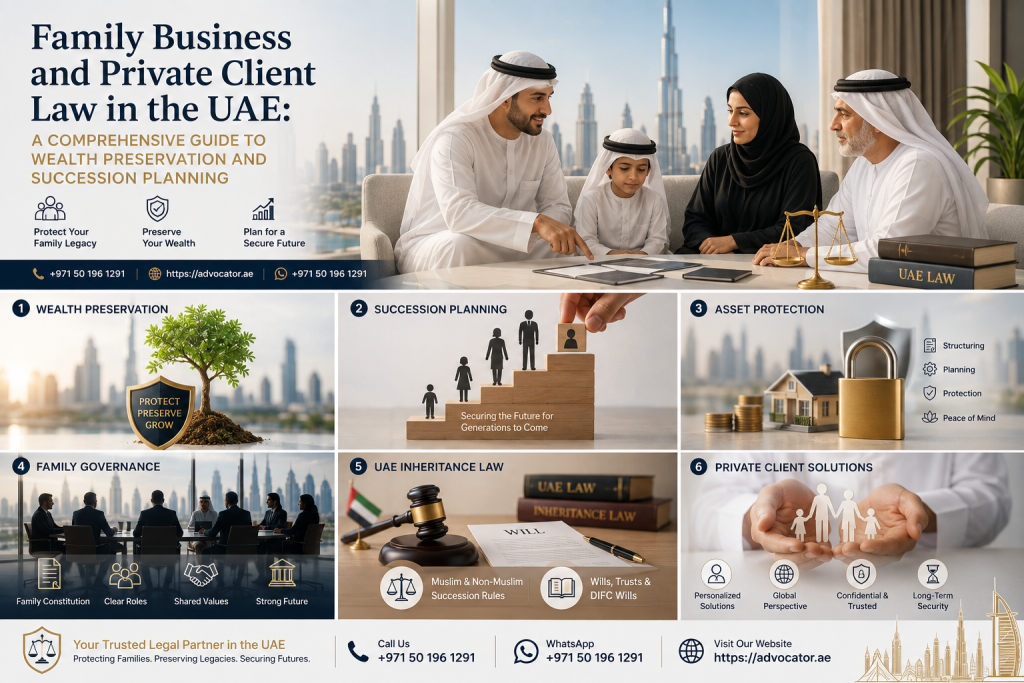

Family Business in the UAE & Private Client Law in the UAE: A Comprehensive Legal Guide
The Rise of Family Enterprises in the UAE
Family businesses are the lifeblood of the UAE’s economy. They represent approximately 90% of all private sector companies, contribute nearly 40% of the national GDP, and employ over 70% of the workforce. These staggering numbers highlight why the UAE government has prioritized creating a world-class legal framework to protect and sustain family enterprises for generations to come.
Family Business in the UAE plays a crucial role in shaping the economic landscape, reflecting heritage and values.
The significance of a Family Business in the UAE cannot be overstated.
The impact of a Family Business in the UAE extends beyond economics, serving as a cultural touchstone for communities.
These enterprises not only contribute to the economy but also embody the cultural heritage and values of the families that run them.
Over the past decade, the UAE has transformed into a global hub for private wealth management, attracting high-net-worth individuals and family offices from around the world. With its strategic location, tax-efficient environment, and sophisticated legal infrastructure, the UAE now stands alongside traditional wealth management centers like Switzerland, Singapore, and London.
Understanding the intricacies of a Family Business in the UAE is vital for entrepreneurs seeking success.
Understanding the framework governing a Family Business in the UAE is essential for any entrepreneur or investor looking to succeed in this dynamic market.
This comprehensive guide explores the legal landscape for family businesses and private clients in the UAE, covering everything from the new Family Business Law to succession planning, wealth structuring, and dispute resolution mechanisms.
This guide outlines how a Family Business in the UAE can navigate legal complexities and thrive.
This guide will delve deeper into what makes a Family Business in the UAE unique, focusing on the legal advantages and challenges that come along with it.
The uniqueness of a Family Business in the UAE comes from its ability to blend tradition with innovation.
Understanding the dynamics of a Family Business in the UAE is crucial for navigating the legal landscape effectively.
For those involved in a Family Business in the UAE, understanding the legal framework is essential for longevity.
As the landscape evolves, recognizing the role of a Family Business in the UAE becomes increasingly important for future generations.
The ongoing evolution of a Family Business in the UAE emphasizes the need for adaptive governance structures.
The UAE Family Business Law – A New Era
Federal Decree-Law No. 37 of 2022: Setting the Foundation
In October 2022, the UAE enacted Federal Decree-Law No. (37) of 2022 on Family Companies, marking a watershed moment for the Family Business in the UAE. This legislation, supplemented by Ministerial Resolution No. 109 of 2023 establishing the Unified Family Business Registry, represents the most significant regulatory development for family businesses in UAE history.
What Defines a Family Business Under the Law?
The law defines a family business as any company established under the Commercial Companies Law where the majority of capital or shares is owned by persons belonging to the same family, provided the company is registered in the Family Business Registry. This definition applies to both existing family companies and those established after the law’s enactment.
Benefits of Registration: Why It Matters
Implementing effective governance in a Family Business in the UAE can ensure future stability and growth.
The Family Business Registry serves as a comprehensive database containing all information related to registered family businesses. Registration offers a range of compelling advantages:
1. Legal Recognition and Protection
Registered family businesses gain official legal status as a “Family Business,” allowing shares to be consolidated within a common register. This prevents fragmentation of ownership among heirs, which could otherwise lead to loss of control or forced sale of assets. The law permits families to impose legal restrictions on the transfer of shares outside the family circle.
2. Institutionalized Succession Planning
The law enables families to adopt formal succession plans and governance structures documented in the Articles of Association and an optional Family Charter. These legally recognized frameworks provide binding mechanisms for leadership transition, helping prevent conflicts when the founder passes away or during generational succession.
For a Family Business in the UAE, this structured approach to succession planning can lead to long-term stability and success, preserving family legacy and wealth.
Registration in the Family Business Registry is a critical step for any Family Business in the UAE to gain legal advantages.
3. Confidentiality with Effective Governance
Registration does not require disclosure of commercial or financial information. Yet it allows families to formally register internal structures such as Family Councils, Family Offices, or Investment Committees. These become legally enforceable in the event of a dispute, while maintaining complete confidentiality.
By understanding and adhering to the requirements of the Family Business in the UAE, families can effectively safeguard their interests.
4. Risk Mitigation Without Registration
Families who fail to register their businesses face significant vulnerabilities:
-
Family Disputes: Conflicts over ownership or leadership can paralyze operations.
-
Wealth Fragmentation: Unnecessary division or forced sale of assets destroys generational wealth.
-
Legal Weakness: Informal family arrangements lack legal standing in courts.
-
Reduced Credibility: Banks, financiers, and potential partners may view unregistered family businesses with skepticism.
The First Registered Family Businesses
In May 2025, the Ministry of Economy announced the registration of the first batch of national companies in the Family Business Registry. These pioneering businesses include:
The first registered entities in the Family Business in the UAE symbolize the commitment to uphold family values while adapting to modern business practices.
The first batch of registered Family Business in the UAE sets a precedent for others to follow.
-
Sharafi Group Investments
-
Al Saud Holding
-
Al Soor Investment
-
SBR Investment
-
Al Rida Investment and Development
-
Manal Family Office Holdings
-
Abdullah Al Mazrouei Investment
This milestone demonstrates the growing acceptance and adoption of the new regulatory framework among prominent UAE family enterprises.

The Family Constitution – Your Governance Blueprint
A family constitution (or family charter) has become an essential governance tool for modern family businesses in the UAE. While not strictly legally binding in all aspects, a well-drafted family constitution codifies long-term goals and agreed approaches to governing business transition.
The role of a Family Business in the UAE is reinforced through established governance frameworks.
Implementing a family constitution is vital for any Family Business in the UAE aiming to harmonize family relations with business operations.
Key Elements of a Family Constitution
1. Core Values and Vision
Articulating the family’s values, mission, and long-term vision ensures alignment across generations and provides a foundation for decision-making.
2. Ownership and Governance Structure
Defining ownership rules, decision-making processes, and roles within the business helps avoid confusion and conflict.
3. Share Valuation and Transfer Rules
Establishing clear mechanisms for valuing shares and regulating their transfer within or outside the family prevents disputes over asset valuation and ownership changes.
4. Family Member Employment Policies
Setting qualification criteria and professional standards for family members wishing to work in the business ensures merit-based appointments and professional operations.
5. Profit Distribution Models
Agreeing on how profits will be distributed or reinvested maintains financial harmony among family members.
6. Conflict Resolution Mechanisms
Establishing internal dispute resolution procedures before disputes arise prevents minor disagreements from escalating into major conflicts.
7. Education and Development Requirements
Outlining educational qualifications and professional development expectations for family members prepares the next generation for leadership.
Why the Family Constitution Matters
A family constitution bridges the gap between tradition and modern governance. It respects family history while establishing professional standards for business operations. The UAE’s Ministry of Economy has expressly recognized the importance of family constitutions, noting that they can set out rules of ownership, objectives and values, mechanisms for valuing shares, profit distribution models, education, and qualifying criteria for family members.
The New Companies Law – Revolutionizing Succession
Federal Decree Law No. 20 of 2025: A Game Changer
October 2025 brought another transformative development with the enactment of Federal Decree Law No. 20 of 2025, amending the Commercial Companies Law. This legislation introduced fundamental changes that directly benefit family businesses and their succession planning.
Legal reforms impact how a Family Business in the UAE manages succession and governance.
This new law is expected to have a profound impact on the operational efficiency of Family Business in the UAE.
The Historic Shift in Shareholder Succession Rules
Historically, UAE limited liability companies (LLCs) and private joint stock companies (PrJSCs) faced significant limitations when attempting to manage succession contractually. Upon the death of a shareholder, shares automatically fell into the estate and were subject to inheritance procedures. This often introduced heirs who had no operational involvement or strategic interest in the business, leading to fragmentation and loss of control.
The New Law’s Revolutionary Provisions
The New Companies Law now expressly permits UAE LLCs and PrJSCs to include in their constitutional documents:
-
Contractual mechanisms governing how shares or interests of a deceased shareholder are to be treated.
-
Rights of first refusal in favor of remaining shareholders or the company itself.
-
Agreed valuation or pricing mechanisms to be applied on the death of a shareholder.
Impact on Family Business Continuity
This fundamental shift allows family businesses to:
-
Centralize decision-making within active family branches.
-
Preserve control and prevent unintended share transfers.
-
Avoid dilution of ownership through forced heirship.
-
Maintain strategic alignment across generations by incorporating mandatory buyout or transfer provisions directly into constitutional documents.
The New Civil Transactions Law
Federal Decree Law No. 25 of 2025: A Complete Re-Codification
The updated legal landscape further supports the operations of a Family Business in the UAE.
On 30 December 2025, the UAE issued Federal Decree Law No. 25 of 2025, introducing a comprehensive new Civil Transactions Law that takes effect on 1 June 2026. This represents a wholesale legislative re-codification of UAE civil law, replacing the 1985 Civil Code in its entirety.
Key Reforms Impacting Families and Private Clients
1. Good Faith in Pre-Contractual Negotiations
One of the most significant features is the formal introduction of duties in pre-contractual negotiations. Article 121 clarifies that all stages of negotiation—including initiation, conduct, and termination—must conform to good faith requirements.
Article 122 further expands the duty to disclose: both negotiating parties are now obligated to provide material and decisive information relating to the negotiation and intended contract. Crucially, any contractual provision seeking to limit or exclude this disclosure obligation is void.
Such recognition is crucial for the sustainable growth of a Family Business in the UAE.
2. Recognition of Framework Agreements
Understanding regulatory frameworks is vital for any Family Business in the UAE to thrive in a competitive environment.
Article 138 officially recognizes framework agreements, which allow parties to predefine essential terms that will govern subsequent contracts. Unless otherwise agreed, such framework agreements are considered as forming part of the definitive contract—a significant benefit for family businesses engaged in regular services and trading contracts.
3. Good Faith as Central Contractual Principle
The New Law embeds the doctrine of good faith as a central contractual principle. Courts are empowered to consider commercial custom, surrounding circumstances at the time of contract formation, and the relative positions of the parties—adopting a more contextual and purposive approach to contract interpretation.
📞 CALL US 💬 WHATSAPP
Private Wealth Structures
Family Foundations: The Preferred Vehicle
Family foundations have emerged as one of the most effective vehicles for succession planning, asset protection, and long-term governance in the UAE. The UAE offers three separate foundation regimes: in the ADGM, DIFC, and RAK ICC.
Choosing a family foundation can be a strategic move for a Family Business in the UAE focused on long-term asset protection.
Why Choose a Family Foundation?
-
Asset Protection: Foundations shield family assets from creditors and legal claims.
-
Succession Planning: They enable seamless transfer of wealth across generations.
-
Governance: Foundations can establish clear rules for management and distribution.
-
Tax Efficiency: Under certain conditions, foundations can benefit from fiscal transparency.
Single Family Office (SFO) Regimes
The UAE has established comprehensive frameworks for family offices across several free zones:
DIFC Family Arrangements Regulations of 2023
-
Requires family net assets of at least USD 50 million.
-
SFOs can be structured as limited companies, partnerships, or foundations.
-
Must be licensed by the DIFC Registrar.
DMCC Family Office Framework
-
Allows free zone LLCs to apply for a specific license to provide family office services to a single family.
-
Transfers of shares outside the family are prohibited.
DWTC Family Office Regime
-
Requires the board of the SFO to be at least 51% controlled by the family.
-
Mandatory office space in the DWTC.
ADGM
-
Currently does not have a dedicated family office regime.
-
SFOs typically structure as restricted scope companies.
-
A public consultation has been conducted, suggesting regulatory changes are likely.
Corporate Tax Treatment of Family Offices
Under Federal Decree-Law No. 47 of 2022 on the Taxation of Corporations and Businesses:
-
SFOs and MFOs that do not qualify for fiscally transparent treatment are subject to Corporate Income Tax (CIT) at the standard rate of 9% on income exceeding AED 375,000.
-
Family foundations and trusts structured appropriately may qualify for treatment as an Unincorporated Partnership.
-
This “fiscal transparency” means income is “looked through” and attributed directly to beneficiaries rather than being taxed at the foundation level.
Conditions for Transparency
To qualify for Unincorporated Partnership treatment, the foundation must satisfy:
This classification enables a Family Business in the UAE to maintain its operational integrity while complying with tax regulations.
-
Purpose Test: Primary purpose must be family wealth management, succession, or charitable activity—not commercial profit-making.
-
Beneficiary Composition: Beneficiaries must consist predominantly of natural persons related to the founder and/or charitable organizations.
-
Distribution Mechanics: Income must ultimately be distributed (or deemed distributed) to those beneficiaries.
-
Control and Governance: The founder must relinquish direct control.
-
Application Timing: Formal application must be submitted before the end of the relevant Tax Period.
For any Family Business in the UAE, understanding these regulations is vital for compliance and operational success.
Succession Planning – Four Essential Considerations
1. Family Constitutions and Governance
Family constitutions have become essential governance tools for modern family businesses. While not strictly legally binding documents, they codify long-term goals and agreed approaches to governing business transition.
Key Elements to Include:
-
Enforceability through shareholders’ agreements.
-
Exit provisions for shareholders.
-
Roles and responsibilities aligned with family hierarchy and professional qualifications.
-
Decision-making processes combining family consensus with clear delegation.
-
Mechanisms for dispute resolution.
2. Ownership Structuring via Corporate Vehicles
Families are increasingly adopting corporate vehicles such as foundations, family holding companies, or trusts to:
-
Centralize ownership: A holding company can consolidate family shares in a separate corporate layer.
-
Minimize inheritance disputes: Using a corporate vehicle instead of personal shareholding provides clarity.
-
Enhanced protection: Family members benefit from liability and risk protection.
-
Provide continuity: Probate occurs at the ownership rather than operating level.
-
Optimize tax efficiencies.
3. Asset Protection Strategy
Effective asset protection requires:
-
Due diligence exercises: Ensuring assets are held as expected (historic ownership restrictions may mean legal ownership doesn’t reflect business needs).
-
Fit-for-purpose structures: Considering whether assets should be held by parallel structures in foundations or holding companies to minimize liability against creditor claims, family disputes, and external challenges.
4. Wills: Aligning Family Wishes with Legal Realities
Wills are critical yet often underutilized in Middle Eastern succession planning. For non-Muslim families in the UAE, Federal Decree-Law No. (41) of 2022 on the Civil Personal Status permits the disapplication of Sharia, providing non-Muslims flexibility in distributing their estate.
Why Wills Remain Essential:
-
Appoint executors: Trusted family members or legal professionals.
-
Address international non-Sharia assets: Assets not governed by Islamic inheritance laws.
-
Complement ownership structures: Ensuring alignment to prevent conflicting instructions.
Dispute Resolution and the Courts
The Judicial Landscape
The UAE offers multiple dispute resolution options for family businesses:
1. Onshore Courts
Following the civil law tradition, UAE onshore courts operate with procedural rules derived from civil law systems. They have jurisdiction over disputes where the defendant is resident in the UAE, the dispute relates to a contract performed or signed in the UAE, or the parties have agreed to UAE court jurisdiction.
The main courts are:
-
Court of First Instance: Hears all cases.
-
Court of Appeal: Hears appeals from the First Instance.
-
Court of Cassation: The highest federal court on matters of law.
2. DIFC Courts
Operating under the common law system, the DIFC Courts are independent from the UAE judicial system. Disputes can be brought to the DIFC Courts if:
-
Both parties have agreed to DIFC Court jurisdiction.
-
The dispute is connected to DIFC operations (party registered in DIFC, contract governed by DIFC law, or dispute arising from DIFC activity).
3. ADGM Courts
Similar to the DIFC, the ADGM operates its own independent court system following the common law tradition.
4. Arbitration
The UAE is a signatory to the New York Convention, which allows parties to enforce arbitration awards across over 170 countries. The UAE has a strong arbitration framework, with the DIFC and ADGM both offering robust arbitration centers.
The UAE has successfully positioned itself as the premier jurisdiction for family business and private client law in the Middle East. Through a sophisticated network of federal legislation—from the Family Business Law of 2022 to the New Civil Transactions Law of 2025 and the modernized Commercial Companies Law—combined with financial free zone regimes offering tailored vehicles for wealth structuring, the legal framework provides everything necessary for preserving and growing generational wealth.
As the UAE continues to enhance its legal landscape for family enterprises, the role of a Family Business in the UAE will become even more pivotal in shaping the economy.
The future growth of a Family Business in the UAE relies on strategic planning and governance.
H.E. Abdulla bin Touq Al Marri, Minister of Economy, has emphasized that family businesses are a key pillar in driving national economic growth and sustainability. He noted that “the UAE has placed considerable emphasis on establishing a sound legislative and regulatory environment to promote the development and long-term sustainability of family businesses in accordance with international best practices.”
The growth trajectory of a Family Business in the UAE is underpinned by these legislative frameworks aimed at fostering stability and growth.
For families, the message is clear: proactive planning, professional advice, and careful structuring are essential. Those who embrace governance through family constitutions, tailor ownership structures to local laws, implement robust asset protection, and draft culturally compliant wills will achieve continuity, harmony, and growth for generations to come.
To ensure that a Family Business in the UAE thrives, it is essential for owners to engage in proactive governance and strategic planning.
For any Family Business in the UAE, effective governance and proactive strategies are key to success.
For Business Owners:
- □
Register your family business in the Family Business Registry.
- □
Draft a comprehensive Family Constitution.
- □
Review your company’s constitutional documents to incorporate succession mechanisms.
- □
Consider appropriate ownership structures (foundations, holding companies).
- □
Ensure you have a valid, legally compliant will.
For Private Clients:
- □
Review your estate planning documents.
- □
Consider establishing a family foundation or trust.
- □
Explore family office structures for consolidated wealth management.
- □
Obtain professional legal and tax advice.
- □
Ensure cross-border asset protection strategies are in place.
For Legal Advisors:
- □
Stay updated on the latest legislative changes.
- □
Advise clients on the benefits of family business registration.
- □
Assist with drafting family constitutions and governance frameworks.
-
□
- Guide clients on succession planning and wealth structuring.📞 CALL US 💬 WHATSAPP
Need Legal Consultation?

Our team of experienced legal professionals specializes in UAE family business law, succession planning, and private client services. We provide:
✅ Expert guidance on family business registration and compliance
✅ Customized succession planning and wealth structuring
✅ Drafting of family constitutions and governance frameworks
✅ Establishment of family foundations, trusts, and family offices
✅ Wills and estate planning under UAE law
✅ Dispute resolution and litigation support
✅ Corporate tax advisory and compliance